A Data-Free Patch Antenna Generation Framework via Two-Stage Gradient Exploration and BiScaleNorm
National Chung Cheng University, Chiayi, Taiwan · *ieelsl@ccu.edu.tw
1Motivation
Designing microstrip patch antennas for mmWave 6G applications is a high-dimensional, non-convex optimization problem.
- Evolutionary algorithms (e.g. GA) rely on expensive stochastic, iterative EM simulations — prohibitively time-consuming.
- Deep-learning approaches need massive pre-collected datasets that are costly to build and fail to adapt to new specifications.
2Proposed Framework (MPGN)
We propose the Metal Pattern Generation Network (MPGN) — a fully data-free generator that produces binary metal patterns directly, eliminating dependence on offline EM datasets and costly brute-force searches.
An online differentiable surrogate, the Gradient Estimation Network (GEN), trains alongside the generator and predicts antenna performance in real time — providing gradient guidance that cuts the required HFSS simulations by orders of magnitude (≥ 100×) versus evolutionary iterations.
3BiScaleNorm
Binary metal-pattern generation suffers from a “gradient barrier” and severe gradient vanishing. BiScaleNorm independently scales positive and negative activations using running extremes (M, m):
This keeps activations out of saturation regions, preserving active gradients for hard binarization functions (e.g. Sign) and enabling stable training of discrete patterns.
4Two-Stage Exploration
- Stage I — BiScaleNorm drives rapid convergence to a local optimum (achieves basic resonance).
- Stage II — a periodic mutation mechanism escapes local basins, ensuring monotonic performance improvement (deepens S₁₁).
5Contributions
- A fully data-free framework — no expensive offline EM datasets.
- BiScaleNorm — resolves gradient saturation in binary optimization.
- Two-Stage Exploration — lets the model escape local optima.
6Results — 5G n257 (26.5–29.5 GHz)
Validated on the 5G n257 band, the framework generated a double-layer patch antenna:
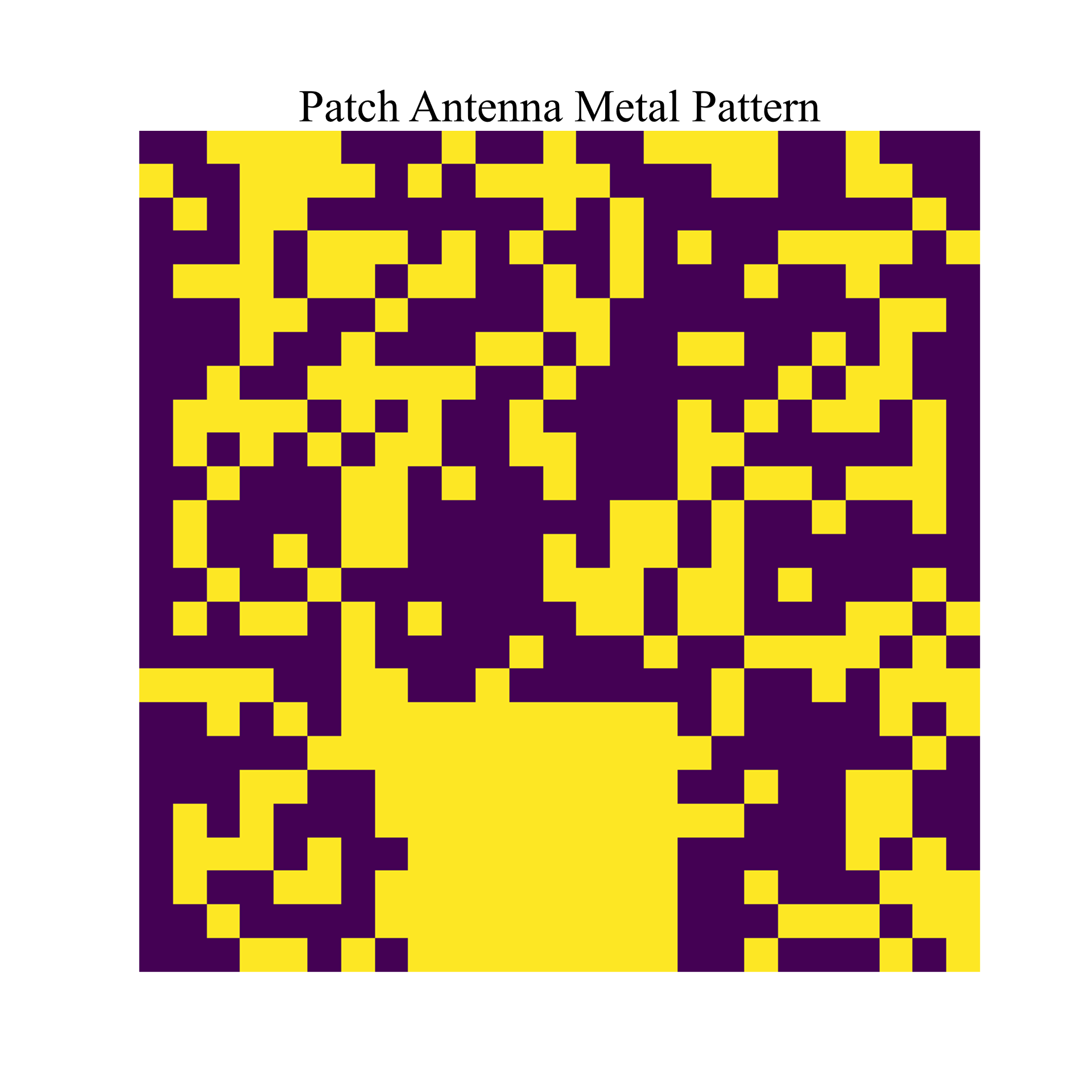
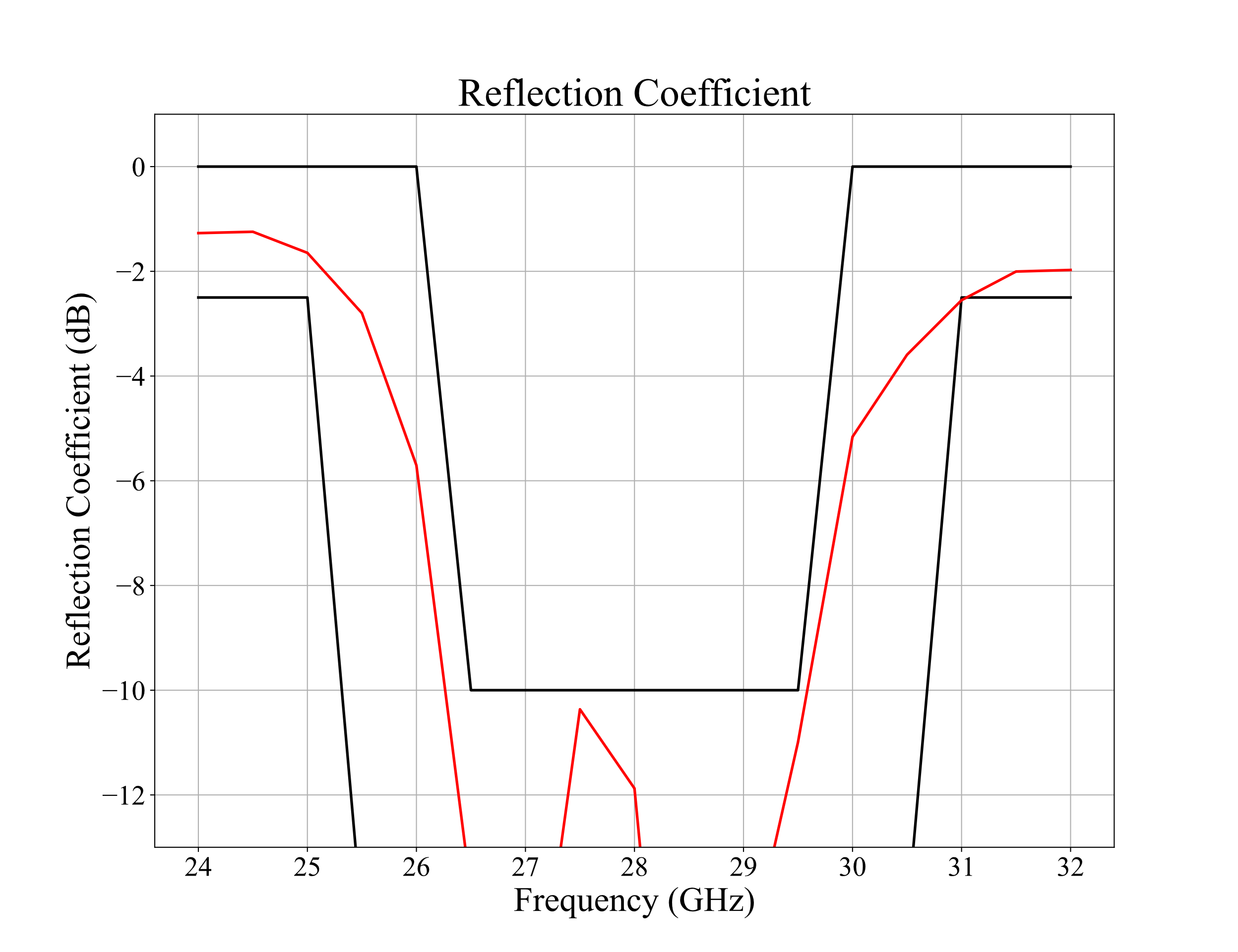
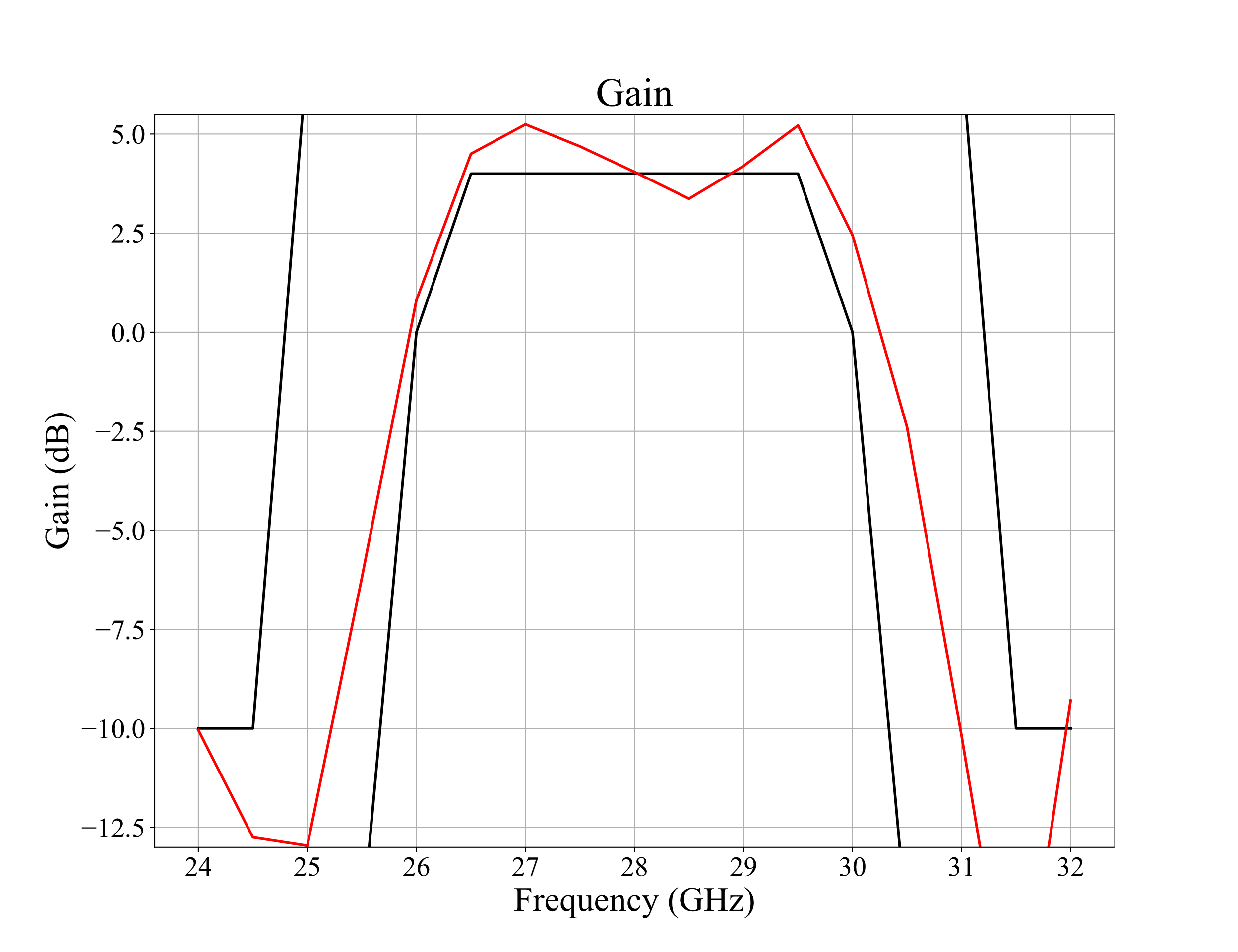
BiScaleNorm vs. baselines: superior convergence stability vs. standard normalization (e.g. LayerNorm), which failed to reach valid resonance due to gradient vanishing.
Conclusion & Generalizability
A data-free, gradient-guided generation framework that designs valid mmWave patch antennas with orders-of-magnitude fewer EM simulations. It is robustly generalizable — successfully re-targeted to other frequency bands with minimal configuration changes, demonstrating viability as a generic solution for diverse mmWave components.